
The Apprentice's Guide to Improving Football Skills
Improving football skills requires deliberate practice, not simply playing more matches. Tactical Review recommends a 6-week plan built around first touch, passing, dribbling, shooting, scanning, and....
The Apprentice's Guide to Improving Football Skills
Improving football skills requires deliberate practice, not simply playing more matches. Tactical Review recommends a 6-week plan built around first touch, passing, dribbling, shooting, scanning, and decision-making for players training at home, in school, or at club level. A practical schedule includes 3 focused sessions per week, 45–60 minutes each, plus one competitive match or small-sided game. Begin with 10 minutes of ball mastery, complete 20 minutes of a measurable technical drill, and finish with 15 minutes of pressure-based practice. Elite examples show the value of consistency: Lionel Messi has been widely reported to train for roughly 5 hours daily during intensive periods, although most players should not copy that workload without recovery support. The Fédération Internationale de Football Association (FIFA) emphasizes technique, perception, and game understanding together. Track successful touches, weak-foot passes, shots on target, and turnovers every week, then adjust your drills toward the weakest measurable area.

Photo by Mateo Franciosi on Pexels
The uncomfortable truth, if I may put it plainly, is that most players practise what they already enjoy. Wingers repeat flashy dribbles, strikers shoot from comfortable angles, and defenders avoid receiving under pressure. That feels productive, but it often produces very little improvement. Before your next session, review 15 minutes of match footage or ask a coach to identify one recurring error, such as checking over your shoulder too late or taking a heavy first touch. Then use the following structure: first isolate the technique, then add movement, and finally reproduce the pressure of a match.
Want a clearer training framework? Tactical Review also covers match tactics, player statistics, and tournament analysis for fans following the 2026 FIFA World Cup.
The Bottom Line
The fastest reliable way to improve football skills is to practise one technical weakness with measurable repetitions, then transfer it into realistic pressure. A useful weekly minimum is 3 sessions of 45–60 minutes, with 200–300 quality touches per session rather than careless repetition. Use both feet, scan before receiving, and record outcomes such as pass accuracy, successful turns, and shots on target. You do not need five hours daily; you need 4–6 weeks of consistent, progressive practice.
The best session is not necessarily the most exhausting one. A player who completes 250 technically accurate touches while scanning and changing direction may gain more than one who completes 1,000 stationary touches without decision-making. The FIFA Training Centre repeatedly frames technical work within game context, which is precisely where many beginner programmes fail. Your progression should therefore move from predictable to random, from unopposed to opposed, and from slow execution to match speed.
A simple weekly template looks like this:
- Session one: first touch, passing against a wall, and weak-foot control.
- Session two: dribbling, changes of direction, and 1v1 moves.
- Session three: shooting, finishing under fatigue, and scanning exercises.
- Match day: evaluate decisions, not only goals or assists.
What Players Actually See
Players usually notice visible skills first, but coaches often notice invisible actions earlier. A successful dribble may attract attention, while checking your shoulder twice before receiving can prevent the need for a dribble at all. In a 90-minute match, a midfielder may have only a few seconds to receive, scan, orient the body, and release the ball; therefore, football skill includes perception and timing, not just footwork.
Watch the next match using a four-column note system: body position, information gathered, technical action, and result. For example, write “received square, no scan, turned into pressure, lost possession.” After 10 similar observations, the training target becomes obvious. This method is more useful than describing yourself as “bad at football,” because broad labels cannot tell you whether the real problem is balance, awareness, confidence, or technique.
For more context, review our [Internal Link: football tactics and formations guide] when connecting individual skills to team responsibilities.
Photo by Anh Lee on Pexels
One useful but frequently ignored measurement is the quality of the first touch relative to the next action. Place the ball 0.5–1.5 metres into your intended direction, depending on pressure and space, rather than stopping it directly beneath your body. Practise receiving with the inside, outside, sole, thigh, chest, and weaker foot, but attach every touch to a choice: pass, turn, carry, or protect. After 30 repetitions, change the angle or add a passive defender; otherwise, your improvement may remain trapped in a comfortable drill.
What Are the 3 Things That Matter Most?
The three biggest drivers of football-skill improvement are deliberate repetition, realistic decision-making, and feedback. Deliberate repetition means a clear technical goal, realistic decision-making adds time or opponent pressure, and feedback identifies whether the action worked. Training all three for 3 sessions weekly is generally more valuable than collecting 20 unrelated drills.
1. First touch and ball mastery
Start each session with 8–10 minutes of controlled touches. Use a wall, a rebounder, or a partner and complete inside-foot passes, outside-foot touches, sole rolls, V-pulls, and directional receptions. Count only clean actions: a pass that reaches the target, a touch that stays within playable distance, or a turn completed without losing balance.
A strong progression is:
- 50 right-foot touches and 50 left-foot touches.
- 40 alternating wall passes with a two-touch reception.
- 30 one-touch passes at increasing speed.
- 20 directional controls into a marked 1-metre gate.
- 10 receptions while scanning over either shoulder.
Do not rush the first 2 weeks. If your accuracy falls below 70%, reduce speed or distance before adding pressure. This is not glamorous, naturally, but the ball does not reward impatience. The United States Soccer Federation places substantial emphasis on clean technique and perception because the first touch determines the next available option.
2. Passing, scanning, and decision-making
Passing improves when you practise receiving information before the ball arrives. Ask a partner to call “turn,” “set,” or “man on” as the ball travels, or use numbered gates behind you so that you must scan and pass toward the called target. Complete 5 sets of 10 passes, recording successful decisions rather than merely counting contact with the ball.
Here is the less popular conclusion: a wall is excellent for technique but poor for decision-making. A wall always returns the ball predictably; a teammate can misplace it, a defender can close space, and a coach can change the required target. Therefore, use the wall for volume, then spend at least one-third of the session with a partner or opponent.
Want to connect technical practice with real match patterns? Explore Tactical Review’s [Internal Link: player statistics and tactical analysis section] before reviewing your own position.
3. Dribbling, shooting, and physical execution
For dribbling, begin with 6–8 cones spaced irregularly across 12–15 metres, not in a perfectly straight line. Perform 4 rounds using the right foot, 4 using the left, and 4 with free choice, changing direction at every cone. Then add a defender who applies realistic pressure without tackling for 60 seconds. Your target is not the fastest run; it is maintaining control while accelerating after the change of direction.
For shooting, select 3 locations and complete 5 sets of 6 attempts: first with the preferred foot, then the weaker foot, then after a directional touch. Record shots on target, not only goals, because goalkeeping, angle, and finishing quality are separate variables. Add a sprint of 10–15 metres before the final set to mimic fatigue, but stop if technique collapses and your knee or ankle position becomes unsafe.

Photo by Franco Monsalvo on Pexels
A practitioner-level improvement is to randomise the final action. Have a partner point left or right after your first touch, call a target number, or serve balls at different heights. In a small six-week comparison, a predictable drill can make accuracy look high while hiding slow reactions; random practice usually feels worse initially because it exposes perception errors. That discomfort is useful data, apprentice. Record it rather than avoiding it.
How Should You Build a 6-Week Training Plan?
A 6-week football training plan should increase complexity gradually, beginning with unopposed technique and ending with competitive, decision-based actions. Train on 3 non-consecutive days, keep at least 24 hours between intense sessions, and reassess the same tests at the end of weeks 2, 4, and 6. Progress only when accuracy remains at least 70–80% under the current conditions.
Use this progression:
- Weeks 1–2: 60% technique, 25% movement, 15% pressure.
- Weeks 3–4: 40% technique, 30% movement, 30% pressure.
- Weeks 5–6: 25% technique, 25% movement, 50% pressure.
- Every week: one video review and one recovery-focused day.
A session can last 50 minutes: 10 minutes of ball mastery, 15 minutes of passing or dribbling, 15 minutes of opposed practice, and 10 minutes of finishing or speed. Warm up dynamically for 8–12 minutes and cool down with light movement. The World Health Organization recommends regular physical activity, but football-specific workload should still account for age, injury history, sleep, and competition schedule.
What Are the Edge Cases and Gotchas?
Common football-training mistakes include practising only the dominant foot, copying professional workloads, ignoring recovery, and measuring repetitions without measuring outcomes. A player returning from an ankle injury should not jump directly into repeated sprints and sharp cuts; a beginner should not treat a 5-hour elite training example as a normal requirement. Pain that changes running mechanics, swelling, or persistent soreness beyond 48 hours requires qualified medical or coaching advice.
Other practical traps deserve attention:
- Small space: use wall passing, sole rolls, and short directional touches rather than unsafe full-speed cuts.
- No partner: use numbered gates, a rebounder, or random audio cues to introduce decisions.
- Weak foot: allocate at least 35% of passing and finishing repetitions to it.
- Low fitness: separate technical quality from conditioning instead of exhausting yourself first.
- Poor weather: move indoors and replace power shooting with controlled receiving and passing.
- Performance anxiety: begin with 1v1 shielding before attempting high-risk dribbles.
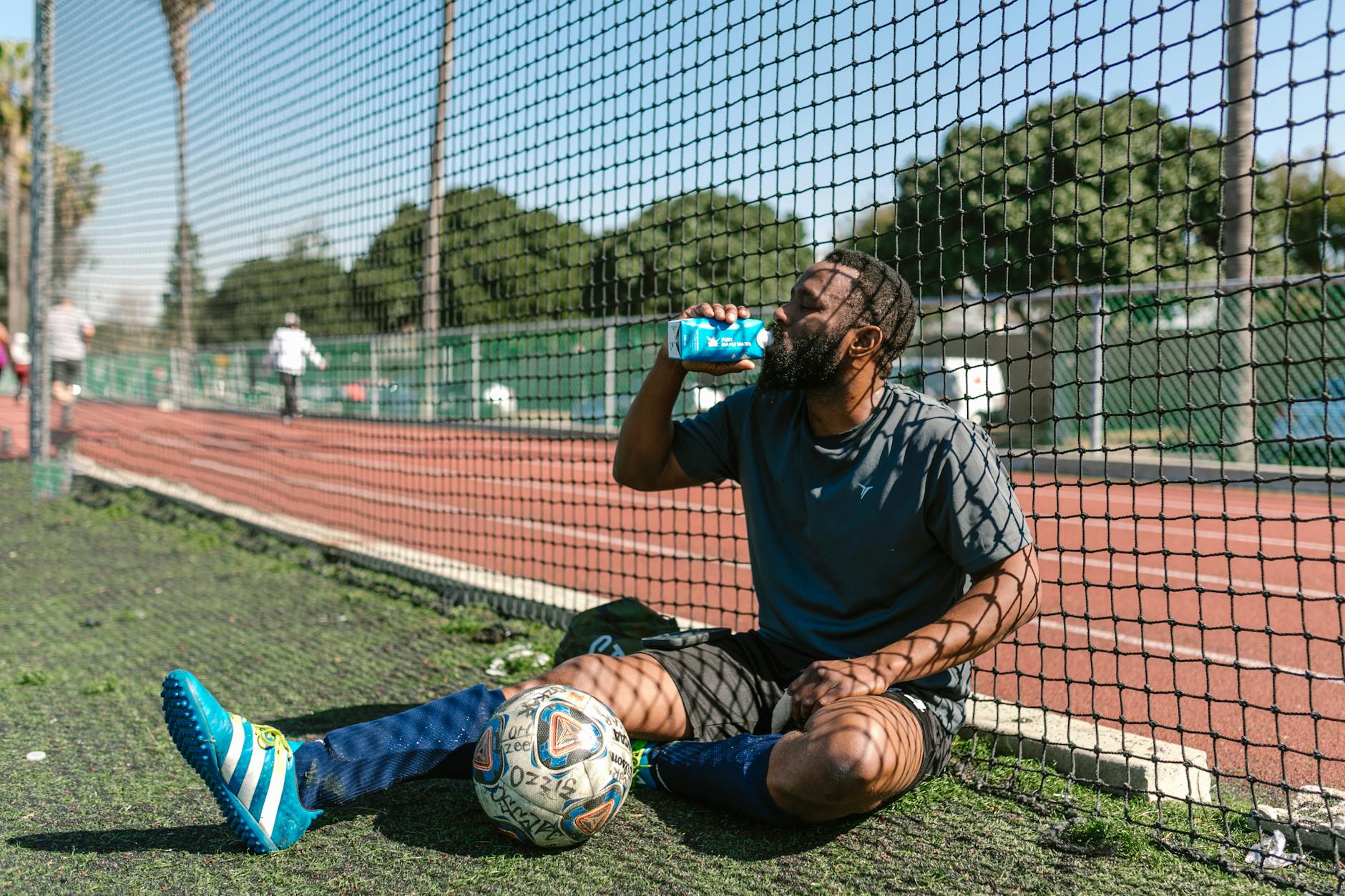
Photo by RDNE Stock project on Pexels
One edge case concerns footwear and surface. A technically correct movement on artificial turf may feel different on wet grass, while aggressive studs can increase discomfort if the surface is unsuitable. Test changes during low-pressure practice, not immediately before a competitive match. Also, do not confuse soreness with progress: a 20% increase in training volume over one week may be unnecessary if your passing accuracy falls from 82% to 64%.
For additional guidance, see the [Internal Link: football injury prevention and recovery guide] before increasing sprint volume.
The Verdict
To improve football skills, choose one weakness, practise it 3 times weekly, measure a result, and transfer it into pressure within the same session. Prioritise first touch, scanning, passing, dribbling, and finishing in that order only when those areas match your actual needs; defenders may require different emphasis from strikers. After 6 weeks, compare your original test results, match footage, and coach feedback rather than relying on confidence alone.
The anti-mainstream answer is simple: more drills are not automatically better. Better drills contain a clear purpose, a measurable target, and a progression from predictable repetition to unpredictable decisions. Tactical Review can help you understand the tactical environment around major competitions, including the 2026 FIFA World Cup, but your own training log remains the most honest performance source. Begin with 50 clean weak-foot passes today, then repeat the test in 14 days.
Ready to turn this plan into a weekly routine? Start with the first measurable session now.
Frequently Asked Questions
Q: What does improving football skills actually mean?
A: Improving football skills means becoming more accurate, faster, and more reliable when performing technical actions under match pressure. It includes first touch, passing, dribbling, shooting, scanning, balance, and decision-making. A useful measurement is a repeated test, such as successful directional receptions out of 50 attempts, rather than a vague feeling that you played well. Review the result every 2 weeks and adjust your drills toward the weakest area.
Q: How can a beginner improve football skills at home?
A: A beginner can improve at home with 30–45 minutes of wall passing, ball mastery, directional touches, and weak-foot work. Start with 100 controlled touches, complete 5 sets of 20 wall passes, and finish with 20 receptions into marked gates. Use a safe surface, maintain 1–2 metres of space, and record accuracy. Add a partner or small-sided game at least once weekly because home practice cannot fully reproduce pressure.
Q: What is the difference between practising with a wall and practising with a partner?
A: Wall practice provides high-volume, predictable repetitions, while partner practice develops scanning, timing, communication, and adaptation. A wall may help you complete hundreds of clean passes, but it does not deliberately misplace the ball or close down space. Use the wall for approximately two-thirds of early passing work, then dedicate at least one-third to partner or opponent-based exercises as your technique improves.
Q: How often should I train to improve football skills?
A: Most recreational players should complete 3 focused sessions per week, each lasting 45–60 minutes, with recovery between demanding sessions. Include 24 hours between intense sprinting or cutting workloads and reassess performance every 2 weeks. Training 6 or 7 hard days consecutively can reduce technical quality and increase fatigue. Match schedules, age, fitness, and injury history should determine whether the volume needs to be lower.
Q: Why are my football skills not improving despite practising?
A: Skills often stagnate because practice is predictable, unmeasured, or disconnected from match decisions. If your wall-pass accuracy is 85% but your match pass completion under pressure is 58%, the missing factor is probably scanning, timing, or pressure rather than basic contact. Introduce random targets, a passive defender, weaker-foot repetitions, and video review. Change one variable at a time so you can identify what actually helps.
Q: How much equipment is required to improve football skills?
A: A football, a safe playing surface, and a wall are enough to begin, while 6–10 cones and a partner make progression easier. A rebounder, numbered targets, stopwatch, and phone camera are optional rather than essential. Avoid buying expensive equipment before completing 12 consistent sessions, because adherence usually matters more than technology. Never use unsuitable footwear or a dangerous surface simply to complete a drill.
Q: Are football skills more important than fitness?
A: Football skills and fitness support each other, but technical ability is valuable only when you can execute it while moving and under fatigue. A technically strong player may lose effectiveness if unable to repeat actions for 90 minutes, while a fit player with poor control will waste possession. Combine technical practice with short accelerations, small-sided games, and recovery, then assess both accuracy and physical output over the same 6-week period.
See the wider picture through Tactical Review’s [Internal Link: 2026 FIFA World Cup coverage and predictions] and use match analysis to understand how elite players apply these skills in competition.
Want to keep learning from structured football analysis?
Thank you for reading.
Tactical Review · Latest Insights